





Richard Froese
South Peace News
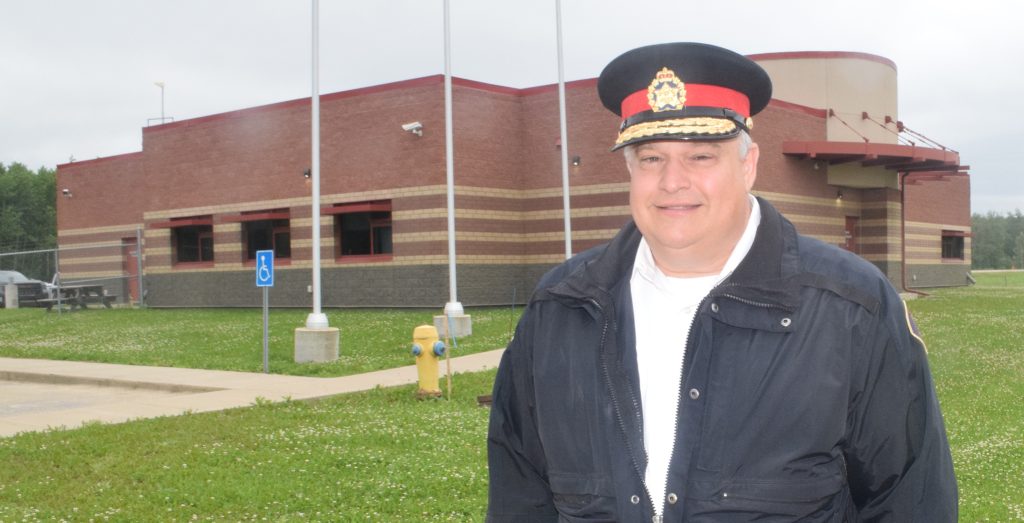
Lakeshore Regional Police Service has a new chief of police but it is a familiar face.
Dean Syniak was promoted to chief of police April 1 to succeed Dale Cox, who retired after serving the top post at Lakeshore for 15 years and 45 years in policing.
Serving with Lake- shore for 14 years and a career spanning three decades, the new police chief is committed to his new role that serves an area including Driftpile Cree Nation, Sucker Creek First Nation, Kapowe’no First Nation and Swan River First Nation east of High Prairie, along with Sawridge First Nation in the Slave Lake area.
“I am honoured to be promoted,” says Syniak, who joined Lakeshore in 2010 as a sergeant and moved up to inspector in 2020.
“I am highly interested in community policing and strive to continue a strong relationship between our service and the nations we police.”
He is dedicated to making communities safer and healthier in various ways.
“My top priorities include strong community-based policing and to ensure we continue to work with local and provincial resources to tackle mental health and addiction issues.”
He is eager to strengthen the police service that has been built by Cox.
“We strive to maintain a strong policing initiative within our First Nations communities,” he says.
“Chief Cox laid out a strong plan and path in policing in our communities.
“The groundwork was already laid out and my intention is to continue in the success of our police service and continue with community commitments and proper policing within the nations we serve.”
He is also committed to building partnerships with Faust RCMP, High Prairie RCMP and Slave Lake RCMP.
“We will continue to build relationships with our surrounding RCMP detachments, which includes assisting in calls for service and in training,” Syniak says.
Plans are also underway to expand the Lakeshore police building that officially opened Oct. 27, 2015.
“The Lakeshore office continues to grow with developments planned for the next year or two,” Syniak says.
Currently, the police service has a staff of 16 sworn police officers, with another currently in training, two inspectors, a victim services unit and a strong crime-prevention unit, he says.
As chief of police, Syniak is accountable to the Lakeshore Regional Police Commission in the overall operations of the service. He says the position was filled internally to provide a smooth transition.
“It was decided an internal hire would help continue the goals and needs of our nations and provide ample opportunity for an internal promotion, which will directly affect retention and morale within our service,” Syniak says.
His policing career began in 1995 at at Hobbema Police Service where he served until 2000. He further worked at the Louis Bull Police Service and Blood Tribe Police until he moved to Lakeshore in 2010.
Before his full-time career, he served as an auxiliary constable with Breton RCMP for three years. Syniak then trained in the policing program at Grant MacEwan College in Edmonton.