





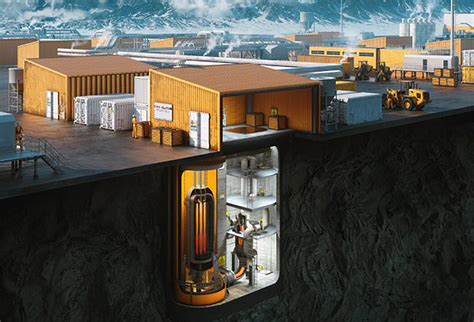
This is a stock image of a possible underground small nuclear power plant to power remote communities or northern military bases.
Will the Peace River country or northern Alberta see a nuclear power plant anyway?
Several years ago, a business group proposed a large-scale nuclear project in Alberta. Locations suggested were slightly north of Peace River or around Whitecourt.
That project never went ahead but the idea may now be returning with different groups.
A few months ago, Nucleon Energy again floated the idea of Small Modular Reactors, known as SMRs. In February, the company hosted three information sessions in Birch Hills County and the Municipal District of Smoky River.
The proposal was reported by the South Peace News in February of 2025. A full report is available online.
Now, another two energy proposals seem to be surfacing. But there is a twist this time around.
The ideas seem to have the blessings of the federal Liberal party. It has also captured the interest of at least three provincial governments, and all three northern territories. Alberta, Saskatchewan, and Newfoundland / Labrador, plus Yukon, North West Territory and Nunavut are all on the table as probable sites for what are planned. This is not the multi-billion dollar conventional large reactors, but the potentially much smaller SMRs. .
The whole scheme itself comes under the umbrella nickname “NPAP – the Northern Power Action Plan.”
According to documents leaked to several media by a confidential source, NPAP talks have been already held between the federal government and the UCP led by Danielle Smith about building at least one, and possibly two, SMRs in Alberta
These so called Small Reactors and can cost far less than the conventional sized reactors already operating in many parts of world, including Canada.
Costs cited could be as low as about $1 billion per installation. This is far less than the $7 to $15 billion a “normal” sized nuclear reactor installation is expected to cost these days. Once in full swing, the entire project could lower the cost to as little as $250 million per installation, or even substantially less.
SMRs are already in use in military vessels like submarines and aircraft carriers. Although SMRs are the normal term used, there are also very small nuclear reactors, called microreactors. In this article we will use the term SMR, the news also applies to microreactors.
But now there is more.
According to the documents, the federal government is not only looking at SMRs, but also at competing with SMRs, or complimentary to SMRs – geothermal energy installations.
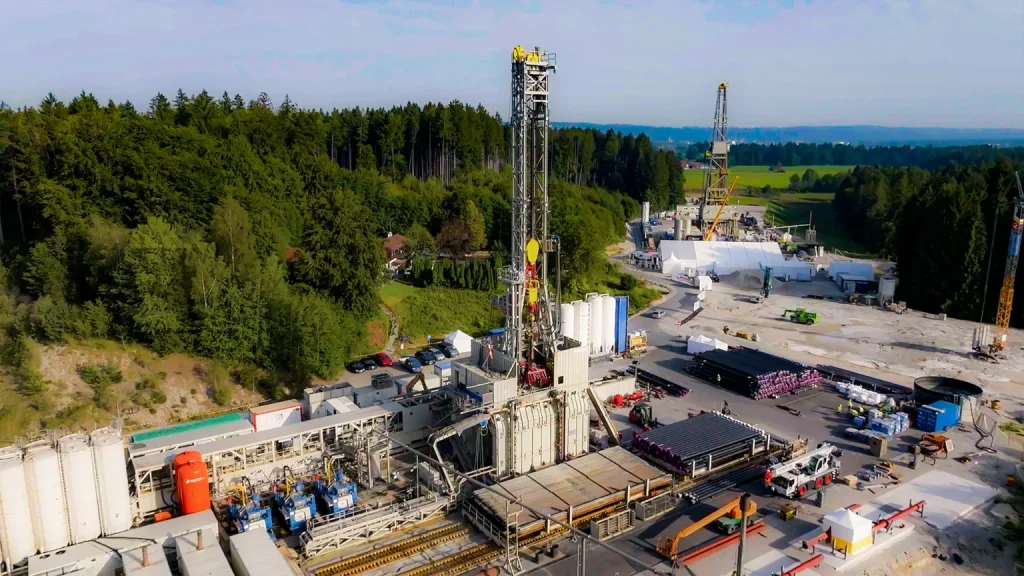
This is a photo of Eavor’s geothermal plant in Europe. Eavor is not a company named in confidential documents leaked by a confidential source.
No companies are named in the confidential documents. But a demonstration geothermal power plant is operating near Rocky Mountain House in western Alberta.
The actual suggestion for the new power plants is what that company, Eavor, calls its Eavor-Deep system.
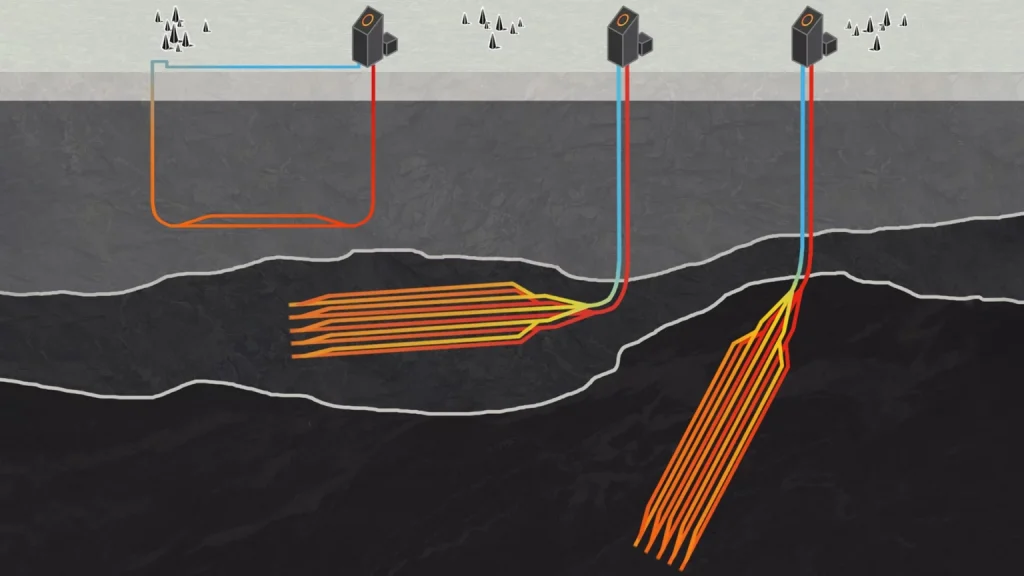
The graphics from Eavor illustrates possible different designs of tapping into heat sources within the earth’s crust. It is not to scale.
This system involves drilling deep holes and tapping into the earth’s internal heat.
Either proposal, or both, are not expected to become election issues. The proposals are only at the discussion stage. But, with mounting pressure from American president Donald Trump in the United States, plus environment pressures from within the Liberal Party itself, it is expected NPAP will be on the table in short order, no matter which party wins the election.
According to the leaked document, the federal government expects to build several NPAP units in isolated and not-so-isolated areas across northern Canada. There are several reasons for the proposal, which is understood to be getting serious discussion at senior levels of government.
First is the federal Liberal government commitment to moving Canada away from fossil fuel use. It is hoped that by persuading Alberta to get on board with nuclear or geothermal, they will help the energy producing provinces move away from supporting conventional oil and gas electric generating facilities
Second, hoped to be of particular interest to Trump, the moves will be billed as part of investment in Canadian military. Although SMRs or geothermal can be built relatively cheaply, the thinking is there will be eventually be enough remote communities and military bases in northerly areas to move the so-called “NATO needle.”
Canada’s defence expenditures are well below the NATO goal of 2% GDP. Investments in NPAP can eventually be expected to total several billion dollars. There are obvious economic and survival benefits to northern Canada. It is presently at the mercy of diesel generators using fuel that all must be shipped, trucked (where there are roads), barged or flown in. As multiple small scale and large scale inland and coastal based military bases are built, this would be a significant contribution to Canada’s overall military spending
Militarily speaking, the wide distribution of SMRs and geothermal in particular, and the ability to secure them underground against attack, makes them much more attractive than solar or wind power generaton. In the same manner nuclear powered submarines are stealthy, land based SMR or geothermal can also be made stealthy, as long as their heat signature is disguised adequately.
Plus, because of their eventual number, possible losses of even several in a combat action would not significantly impair total capability of the entire NPAP ‘fleet.’
Another attraction of either SMR or geothermal is the investment in technology is very saleable around the world. As Canada develops improved technical ability, NPAP facilities would be sold to developing countries, enabling them to bypass polluting fossil fuel generation. This should be particularly attractive to countries like India and China, which are currently building and starting up coal and other fossil fueled generation facilities numbering in the 100’s per year.
It should be noted only China and Russia have themselves built operating SMRs. But according to Wikipedia, there are “more than 80 modular reactor designs under development in 19 countries.”
Because of the hoped for low operating cost, many developing countries would find NPAP generators a viable solution for their own energy needs. Plus the federal government already has agencies like the Export Development Canada and other banks ready to lend money.
Another huge plus for the NPAP units is less of a need to run hundreds or even thousands of miles of power lines across remote landscapes. The actual installations are expected to service homes, businesses, industry and installations just within several miles of the actual power facility.
Operating costs of either SMRs or geothermal units are far less than any fossil fuel installations. As well, they are flexible enough to produce what is called “base load” power that can be easily scaled up practically instantly if demand increases. This is far better than both solar and wind and matches the capability of fossil fuel generators.
In what seems like a both for and against argument about economic potential, BASE, the German Federal Office for Safety of Nuclear Waste says it would take several thousand or tens of thousands to equal the 400 or so large nuclear reactors operating in the world today.
Yet another plus for NPAP units is the pressure within the Liberal party to continue to be environmentally super-conscious. Appeasing this “Green” wing both inside and outside the party has much appeal. An added bonus is there would be little resistance in population dense regions like southern British Columbia and Central Canada where NPAP units would not be located.
The federal Liberal party remains unsure if building out NPAP in Alberta would be a good election move for them in the current campaign, but so far all indications are, it thinks it is an long-term idea worth pursuing.
The News is in the process of contacting local area governments but as of this time, has not had responses from anybody.
by News / Leader / Express Staff
Editor’s Note: Thanks to our readers for participating in our April Fool’s Joke. It should be mentioned Canada has just approved an actual working SMR at the Darlington, Ontario location. In addition, Eavor does in fact have a facility at Rocky Mountain House in Alberta, and also in Europe.