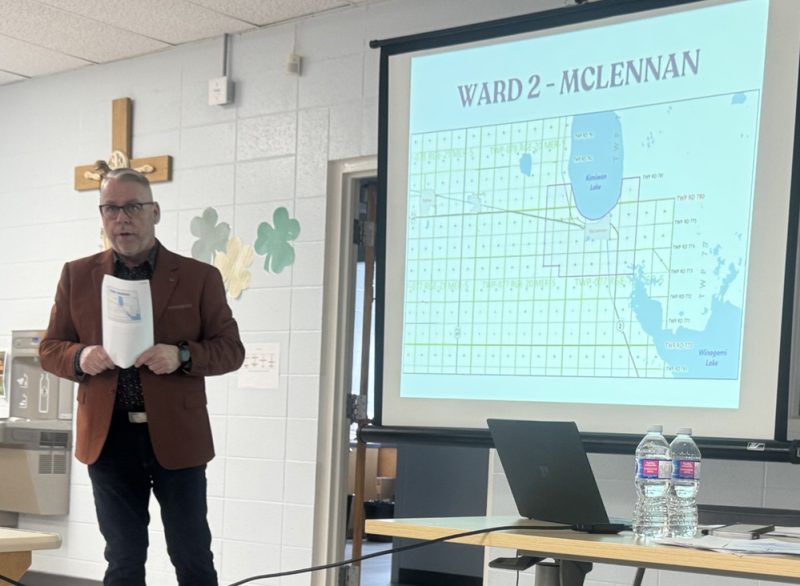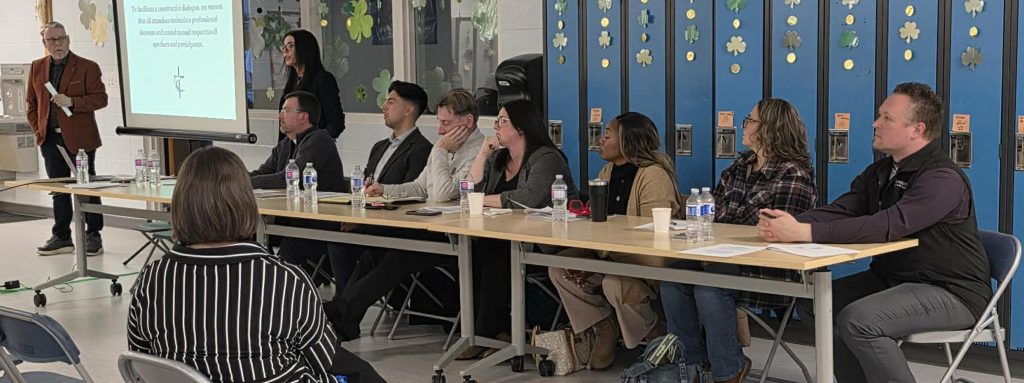
On March 12, Holy Family Catholic Regional Division’s board of trustees held a public meeting at Ecole Providence in McLennan with the public to discuss the school’s future.
Providence had just 32 students enrolled at its facility in September, putting the school at risk for a significant drop in funding from the Alberta government. At its current state, the school will be facing a deficit of over $700,000 this educational year.
“Every school division in Alberta has a school viability policy,” says board of trustees chair Kelly Whalen.
“These are the criteria that we have to follow in order to ensure that the taxpayer dollars are being spent effectively and it’s not causing a burden on other students within our Division and for us to be fiscally responsible.”
The policy is meant to be used by the board to assist it to objectively identify schools that may need to be considered for closure of some, or all grade levels based on number of students in each class and other factors.
Holy Family’s Policy 15 is School Viability/Closure. It includes stipulations including if there are three consecutive grades with enrollment less than seven students, there are or are projected to be more than three grades in a classroom, or there are or are projected to be 30 or fewer students in various grade levels (kindergarten to Grade 5, Grade 6 to Grade 9, Grades 10-12). Also included is if the critical minimum enrollment level is reached, parents with children in the school may be notified even if school closure is not being formally considered at that time, that the school may be considered for closure in the future.
The final stipulation in the board’s Policy 15 is what triggered the need for the meeting in McLennan.
“We only get paid for the number of students that are registered at our school on Sept. 30, any other influx or loss of students after that day doesn’t affect our funding,” says Whalen.
Other factors that would affect the decision of closure include how the closure would affect the attendance area, how it would affect other schools, the number of students who would need to be relocated, the need for busing, program implications for other schools and their students and other educational and capital and infrastructure concerns.
The school has had low enrollment numbers dating back a decade, with the most significant drop at the beginning of this school year. The highest number of students enrolled in the last decade was in 2021 when the school reached 66 pupils, the remainder of the decade the enrollment hovered between 47-60 pupils, with this school year noticing its most significant drop in enrolment.
“This year at Sept. 30, we were at 32 students,” says Supt. Victoria Cornick. “So, with an average class size of four students.”
Cornick explains the rural small school grant aims to assist small schools in rural Alberta based on school population. Ecole Providence used to be in group 3 for funding, but in the last two years the school has been funded in group 2.
“For the Rural Small School Grant revenue, our school has dropped to the second lowest group,” says Cornick. “So, we have lost $184,000 in funding. If we drop below 35 students, which we did this year based on our enrolment, we risk falling to the lowest group.”
She added the grant is based on an average of the last three years of enrolment, so if Ecole Providence’s average for three consecutive years falls to below 35, the school will fall to the lowest group in the grant funding, and Holy Family will lose another $287,000 of funding.
“That’s where the enrolment really affects the funding,” says Cornick.
“Other revenue allocation, allocated by taking the total of all other non-targeted funding sources and we average across all of our schools in the school division based on the enrollment. For this school two years ago we could allocate $819,000, then it went to $645,000, and now down to $425,000 for other revenue.”
Cornick says as enrollment drops to critical levels there is a compounding negative effect on funding allocation. Cornick says school divisions are facing significant cost increases with staffing, maintenance and other costs including insurance, busing and other factors.
“Total operating costs have remained very stable but are expected to rise as inflation impacts the high spending areas of staffing, utilities, and insurance,” continues Cornick.
“Annual operating deficit has been increasing, resulting in the high costs being funded out of reserves, taking from revenues that would be fairly allocated to support other students.”
Cornick says for the school to break even the enrolment count would need to be at 60.
In 2023-24, the school had a deficit of $51,900, the following year the deficit increased significantly to $432,000, this year the school will face a deficit of $697,931 (even with the month off of school during the strike).
The cost per student for Ecole Providence in 2023-24 was $27,539, last year $33,280 and this year every student’s cost is $50,313. Comparing this to the other student cost in the Division, student average is $20,500, compared to $50,313 in McLennan this year. This means each student at Ecole Providence is costing 2 1/2 times more to educate than students at any other school in the Division.
Whalen adds that at a board and financial level there have been various options explored including staying as a kindergarten to Grade 8 school, becoming a kindergarten to Grade 6 school, becoming a kindergarten to Grade 3 school, and school closure.
“Now there is an opportunity for councils and affected municipalities to provide a statement to the board by April 14,” says Whalen. “Concerned electors (residents) can provide written responses or attend the board meeting on April 14 in Peace River. We will make a decision (regarding closure) that day unless there are extenuating circumstances.”
During the question period, members of the crowd voiced concerns about why students are being bused out of the community to other schools, to which the board answered families have the choice as to where they send their children to school. They answered parents have the choice to send their child to a public school or the Catholic school.
Others asked if there was possibility of expanding programming to interest more students in attending Ecole Providence, whether the board attended Catholic services in the region to solicit students to the school, expanding the boundaries of the school, adding more special needs space to the school, or renting out spare space to a playschool program.
At this juncture, the next steps for Holy Family is to meet April 14 to discuss the conversation and all the information collected at the March 12 meeting. During its meeting and after the discussion, the board will also have a conversation about the school’s future, after which they will decide what steps to take.
Both Whalen and Cornick urged concerned parents and attendees to talk to their Member of Legislative Assembly and to write a letter to the board of trustees with concerns.
Emily Plihal
Local Journalism
Initiative Reporter