





Emily Plihal
Local Journalism
Initiative Reporter
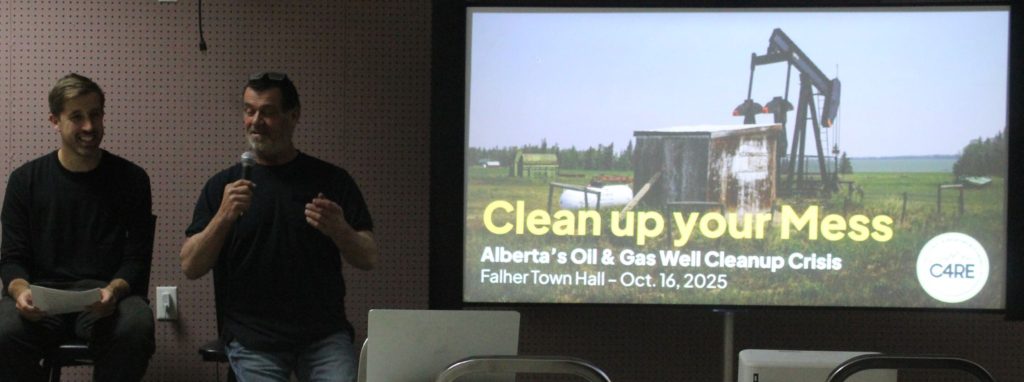
The Coalition for Responsible Energy (C4RE) hosted a meeting in Falher at the Club Alouette on Oct. 16 to discuss various concerns regarding both active and abandoned wells and pipelines in Alberta.
C4RE is a coalition of landowners, scientists, surface rights advocates, and Indigenous, environmental, human health and civil society organizations. The group was formed originally because of shared concerns over the Alberta Energy Regulator (AER) but have since branched out to other related campaigns. The group was represented by Mark Dorin and Phillip Meintzer.
Local farmer Ron Desaulniers introduced the organization and spoke to some issues he has regarding “the wells that are across from my yard are deemed sour. They left this line bleed off into my yard, with no supervision and no monitoring. Just kind of left it bleed off.”
Desaulniers is vocal about his concerns regarding not having adequate accountability put on the companies in the Smoky River Region and province because of this own experiences.
“My wife smelled the gas, and we probably should have left the house, but we didn’t,” says Desaulniers of the sour gas that leached underground into his yard, adding that it’s been a nightmare since.
“This group can help us change the government’s mind into not giving free reign to these oil companies.”
C4RE’s Phillip Meintzer says environmental groups like the one he formerly worked for were not speaking with rural people who were actually impacted by infrastructure and living with it on their land. He says communities that were directly impacted by the oil and gas Industry were being largely ignored, which was what inspired the need for C4RE to be created. He says now there is no legislation coming that could seriously impact Albertans.
“The provincial government is planning to bring alarming changes to Alberta’s oil well cleanup rules this fall,” explains Meintzer.
“The government is calling it the Mature Asset Strategy (MAS), but it’s really just a scheme that weakens industry cleanup obligations at the expense of everyone in Alberta and the land and water that we depend on.”
Meintzer says over the past century, there have been over 470,000 wells drilled in the province, which equates to approximately one well for every 10 people in the province. There are also 450,000 kms of pipeline and 40,000 facilities.
“Less than 60,000 of these wells are currently active, so that means producing more than 10 barrels each day,” Meintzer notes.
“Nearly 270,000 of them are at or near the end of their lives. They’re not producing much or have been inactive for decades and they have to be cleaned up at some point.”
Meintzer says in both Alberta and Canada, there the Polluter Pays Principal is the law. Meaning, if you make a mess, you clean it up, and you also pay for the clean up. He explains, with new MAS legislation, the onus of financial obligation to clean up wells could end up falling on Albertans.
“What’s it going to cost to clean up wells, ignoring all pipelines and facilities, 2021 estimate using AERs own methods to develop a figure and the best-case scenario is $40 billion and worst case $70 billion,” Meintzer explains.
“Internal AER estimates say it could be as much as $130 billion when pipelines and facilities are included. In Alberta, we currently hold less than one per cent of those costs from industry as security for when those companies go bankrupt or fail to pay.”
Meintzer explains it is not that the companies don’t have the capital to pay for it. He explained in the past four years alone, companies that operate in Alberta’s oil and gas industry posted a combined profit of almost $150 billion.
“Industry has more than enough to pay, but our government and regulator are failing to hold these companies accountable, so they’re giving that money to their shareholders and executives instead,” he explains.
Meintzer adds that companies are also off-loading their wells onto smaller companies that can’t afford to complete the cleanup, going bankrupt, while bigger companies walk away with money in hand.
“We’re also seeing companies refusing to pay compensation to landowners, skipping out on their municipal property taxes, which then forces counties to cut services or raises taxes on everyone else,” Meintzer stresses.
“Albertans are already covering a number of these costs through subsidies and other handouts. $1.7 billion in federal funding that was given to Alberta for cleanup in 2020, or the $30 million that Albertans paid to cover unpaid compensation to landowners last year.”
Meintzer says that many of these issues could be resolved if current laws and regulations were being enforced. Instead, he says the government has put together a plan that will make it even easier for companies to abandon their obligations at the Alberta taxpayer’s expense.
He explains the Mature Asset Strategy was released on April 3 and includes 21 recommendations to manage mature oil and gas assets in Alberta. He adds that instead of forcing companies to be accountable, it is essentially an industry wish list.
He says the worst of the strategies include passing legislation to create new Crown corporation entities that would acquire junk wells from companies or any infrastructure they deem unprofitable. There are recommendations of repurposing well sites, like adding solar panels, so companies can avoid full cleanup. The intend on reducing reclamation standards, especially related to salt and gas venting.
He explains the report recommends risk-based closure, which he says seems to be about prioritizing the least expensive sites for cleanup, which could mean that many wells go unplugged, especially those that are harder and more expensive to reclaim.
“Mature Asset Strategy mentions additional financial support could be used to accelerate closure, but it doesn’t say where money would come from, if not from taxpayers,” Meintzer notes.
“The report states they want to increase gas demand, like through AI data centres to artificially raise gas prices. Help keep some wells profitable for longer, but then the rest of us would be forced to pay higher prices to keep these companies afloat.”
He says the formulation of MAS is problematic, adding that it was created in six months, behind closed doors, with no public consultation. The process, Meintzer says, was dominated by reps from the oil and gas industry with 70 of 98 participants from the industry, with only 10 from municipal or rural interests.
“Overall, the recommendations won’t fix the problem, but they will allow the companies to walk away and not be on the hook for cleanup,” Meintzer says.
“Public money should be funding our public services like heath care, education, our infrastructure, not lining the pockets of executives.”
Meintzer says the $70 billion clean up estimate could fund the entire 2025-2026 education budget seven times over. He feels that money should be going to public services, not funding the companies.
Smoky River Region farmers have felt many of the aftereffects of oil companies forgoing responsibilities to landowners and municipal government. Landowners from across the area were not paid by Long Run Exploration for multiple years, with the company eventually going bankrupt. The M.D. of Smoky River lost a large portion of its linear taxes due to the company not being paid, with complicated budget decisions now having to be paid. These concerns are not uncommon, and both Meintzer and his colleague, landowner representative on surface rights issues Mark Dorin, say MAS will only increase the problem for Albertans.
Dorin says there is an Orphan Fund in Alberta that is meant to be landowners’ safety net, but the provincial government needs to start keeping companies accountable for their cleanup responsibilities.
“Industry 25 years ago said, ‘Don’t make us pay security, let us transfer our wells to whomever we want. Don’t oversee us and we collectively, as an industry, will pay for the closure costs of those’,” says Dorin. “That’s what they asked for and that’s what they got in 2000, encoded in law, that’s still our law today.”
He explains the current amount that the Orphan Well Association needs today to retire the wells on their books, not including Long Run’s abandoned wells and sites, is $1.2 billion.
“It’s the AER’s (Alberta Energy Regulator’s) job to levy an amount on industry each year, according to three factors, that are statutory factors, and they’re only ordering industry to pay $144 million this year,” Dorin says.
“That’s why all these wells take so long to get cleaned up by OWA and that’s why all you people, when you file to the government that Long Run isn’t paying you, the government will pay you for 20 to 30 years until the OWA gets around to cleaning it up.”
Both Meintzer and Dorin say the bottom line is our government needs to start forcing the law in Alberta, so the onus of reclamation is not put on landowners and provincial taxpayers.
“Make industry pay and not us,” he says.
“That is the message we have to give and the way you do that under the current law is properly funding the Orphan Fund, which they’re not doing,” he adds.
The men urge concerned Albertans to start communicating with their Members of the Legislative Assembly and Premier Danielle Smith, asnd to speak with local councillors and attend any local meetings addressing surface rights.