





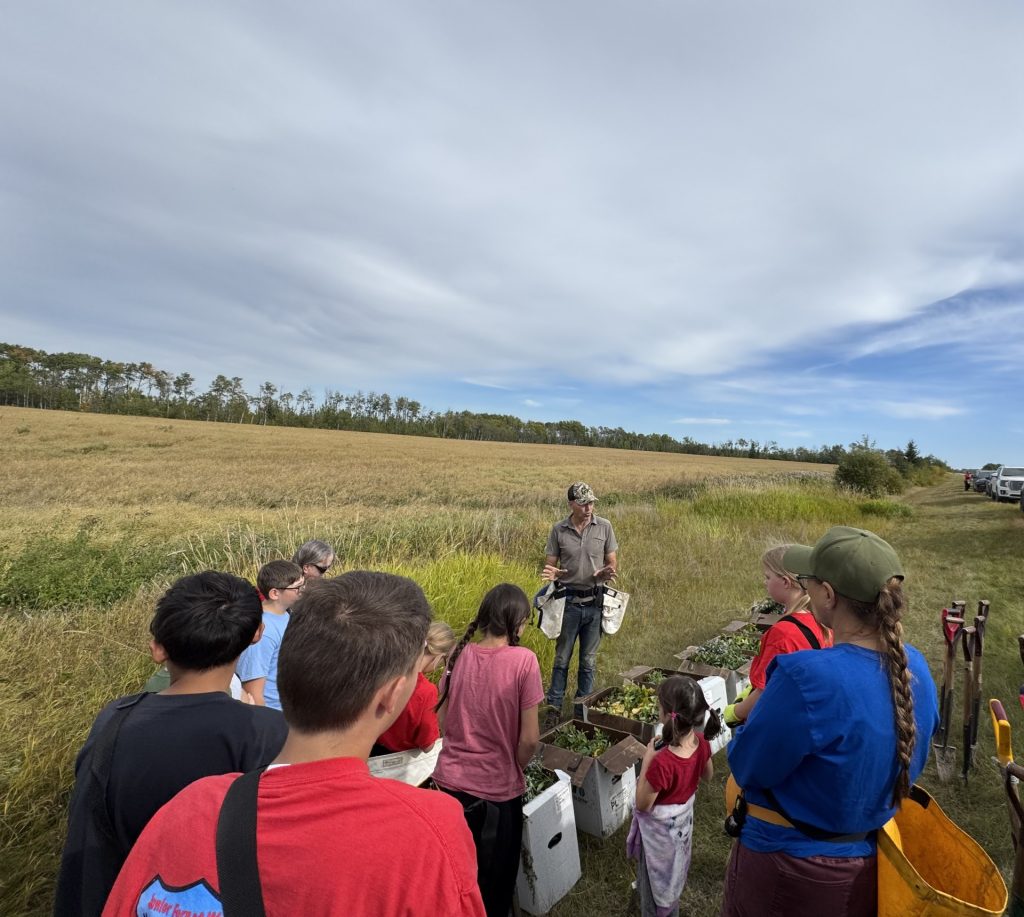
A fall planting campaign aimed at protecting small tributaries of the Peace River has put thousands of new saplings in the ground.
Michaela Regimbald, a summer watershed steward with the Mighty Peace Watershed Alliance (MPWA), says the Sept. 28 planting day went well despite drawing no volunteers from the general public.
Staff and representatives from the NAIT Centre for Boreal Research and Northern Sunrise County volunteered their help, while Junior Forest Wardens and local students assisted during a separate planting day.
“It went well,” Regimbald says. “We didn’t get any volunteers from the general public to join us, but partner organizations helped move the planting forward.”
The work is part of the MPWA’s Peace River Small Tributary Project, an initiative intended to protect the health of the smaller waterways that feed the Peace River. The project focuses on revegetating vulnerable creek banks and helping agricultural producers continue farming alongside those waterways.
Regimbald says the MPWA has partnered with several landowners, including one whose property contains an ephemeral creek — a channel that is wet only at certain times of the year. Water flowing through the creek has caused erosion, raising concern that the farmer could lose productive land.
Working with the landowner, MPWA placed orange stakes to mark a buffer about one metre from the edge of the creek. The boundary is intended to prevent spraying close to the channel and allow plants to remain in place, strengthening the soil around the bank.
“The less vegetation there is, the looser the soil becomes which causes more erosion,” Regimbald says.
Over roughly the past month, the alliance received 7,000 saplings grown by the NAIT Centre for Boreal Research in Peace River. The young trees have been distributed among tributary restoration sites, including one near Fort Vermilion where a few hundred were planted.
On Sept. 16, Regimbald organized a planting day with a Grade 8 outdoor education class from Holy Family Catholic Regional Division in Peace River. Together, the students planted 1,200 saplings.
Another planting day brought together local Junior Forest Wardens, the Smoky River Bears Forest Warden group and the Peace River Wolverines Forest Warden group. Regimbald says those participants were able to put considerably more saplings into the ground.
Even after those efforts, about 3,000 saplings remained, prompting the alliance’s call for additional volunteers on Sept. 28. By the end of that day, roughly 600 were still unplanted. Northern Sunrise County now plans to use them at another location.
Regimbald says the plantings are designed to provide long-term benefits beyond simply stabilizing a single creek bank. Establishing trees and other vegetation can slow runoff, hold soil in place and improve conditions along waterways that ultimately connect to the Peace River.
For farmers, the project offers a way to protect both the tributary and the land they depend on. The campaign has relied on a series of coordinated planting days rather than a single large event. The school class, Forest Wardens, research centre staff and county representatives each contributed to the overall total.
With the remaining 600 saplings expected to be planted at another location, the full shipment will continue supporting restoration work across the region. Regimbald says the MPWA also wants residents to better understand why the work is being done and how local participation can support it.
The absence of volunteers on Sept. 28 may have reflected limited awareness rather than a lack of genuine interest, she says.
“We also hope the community knows about our projects,” Regimbald says.
“I think if the community knew a bit more about the project, we may have had more volunteers.”
Sara Driedger
South Peace News