





Joe McWilliams
For South Peace News
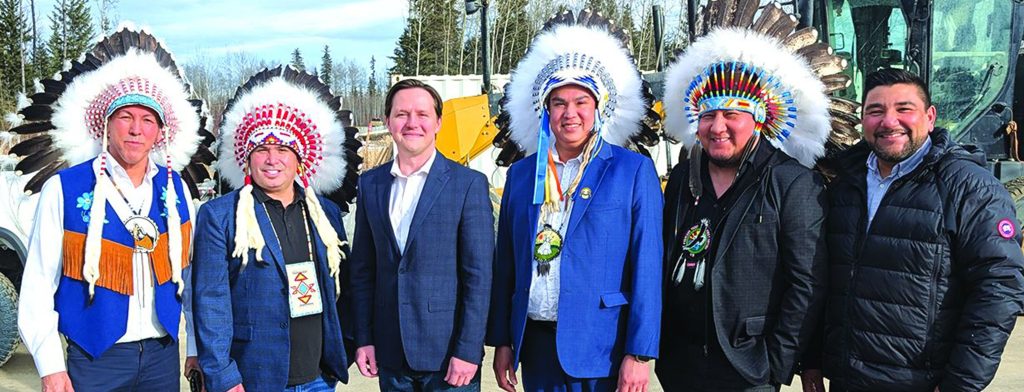
Alberta’s Minister of Transportation Devin Dreeshen was in Wabasca on March 4 to announce funding for the Hwy. 686 extension project.
The money is earmarked for the next three years, to get the engineering done and construction started on the new connector between Peerless Lake and Fort McMurray.
Also at the announcement were the chiefs of four First Nations with a stake in the project. One was host Chief Andy Alook of Bigstone Cree Nation. The others were Chief Gilbert Okemow of Peerless Trout First Nation, Chief Ivan Sawan of Loon River First Nation and – recently added to the group – Chief Raymond Powder of the Fort McKay First Nation, near Fort McMurray.
Fort McKay wasn’t one of the First Nations that formed an economic development partnership in 2023, specifically as a vehicle for their involvement in the 686 project. But under Powder’s leadership, Fort McKay FN is now looking at becoming the fourth member of United Northern Developments Limited Partnership (UNDLP).
In their remarks, the chiefs spoke mainly about three things: the need for escape routes when forest fires threaten, economic development opportunities, and last but certainly not least, the need to balance economic development with protection of the natural environment.
There was a fourth aspect that was mentioned more than once: the opportunity for First Nations “to be in the driver’s seat,” as Sawan put it, for projects such as this one that take place on traditional First Nations territory. The 686 project is apparently ground-breaking in that regard.
Dreeshen acknowledged this in his remarks, saying the government “flipped the script,” on the project, departing from the usual procedure.
Dreeshen said normally, when there’s a new road being planned, the government will hire an engineer to come up with a proposed route, put that on a map and then present it to the concerned stakeholders for feedback. In this case, the Province handed the concept of the new highway to the three First Nations with no specific route designated.
The chiefs have been consulting their members on where they think the road should go. The Province provided $2 million initial funding to help with the process.
Dreeshen, in answer to a question from a reporter, said that the consultation is nearly complete. What happens next, he said, is the hiring of a firm to do detailed design on the approved route. Once that’s done, the construction job will be put out to tender.
Dreeshen added construction on “the easier parts,” might start as soon as this fall. That would be on either end of the proposed 218-km route between Peerless and Fort McMurray. For the bulk of it, though, there’s a lot of work to be done, and Dreeshen said “it’ll be very expensive.”
Treaty 8 Grand Chief Trevor Mercredi had a few interesting things to say. For example, he suggested the new highway could (or maybe should) be named by the First Nations. Other highways, too.
We’re talking about transportation corridors, Mercredi said: “We can also discuss wildlife corridors.”
A Canadian Press reporter asked the minister to comment on Hwy. 88. He mentioned Slave Lake Mayor Francesca Ward’s recent comments on the proposed Alberta budget, in which she was critical of the government for underfunding northern infrastructure.
Dreeshen’s UCP caucus colleague Scott Sinclair (who was in the room, but not asked to speak), the MLA for Lesser Slave Lake, had issued a similar critique of the budget, saying he wouldn’t be voting for it.
Dreeshen said the widening of 34 kilometres of Hwy. 88 is going ahead. If it had just been resurfacing, it would have been done sooner, but the communities made it plain they wanted it widened, among other improvements. Major construction on the project is expected next year, he said, “if the budget is passed.”
Dreeshen added that of the $8.5 billion Alberta plans to spend on roads and bridges over the next five years, $4.6 billion is earmarked for rural (i.e. not Edmonton or Calgary) Alberta.
It’s worth noting that although the section of 686 connecting Peerless Lake and Trout Lake is not part of the proposed highway connection with Fort McMurray, the paving of that 20 kilometres is part of the overall project. It’s an important one too, which Chief Okemow stressed in his comments.
“This part of this project is close to our hearts,” he said.
“That dirt road isn’t safe.”