



Emily Plihal
Local Journalism
Initiative Reporter
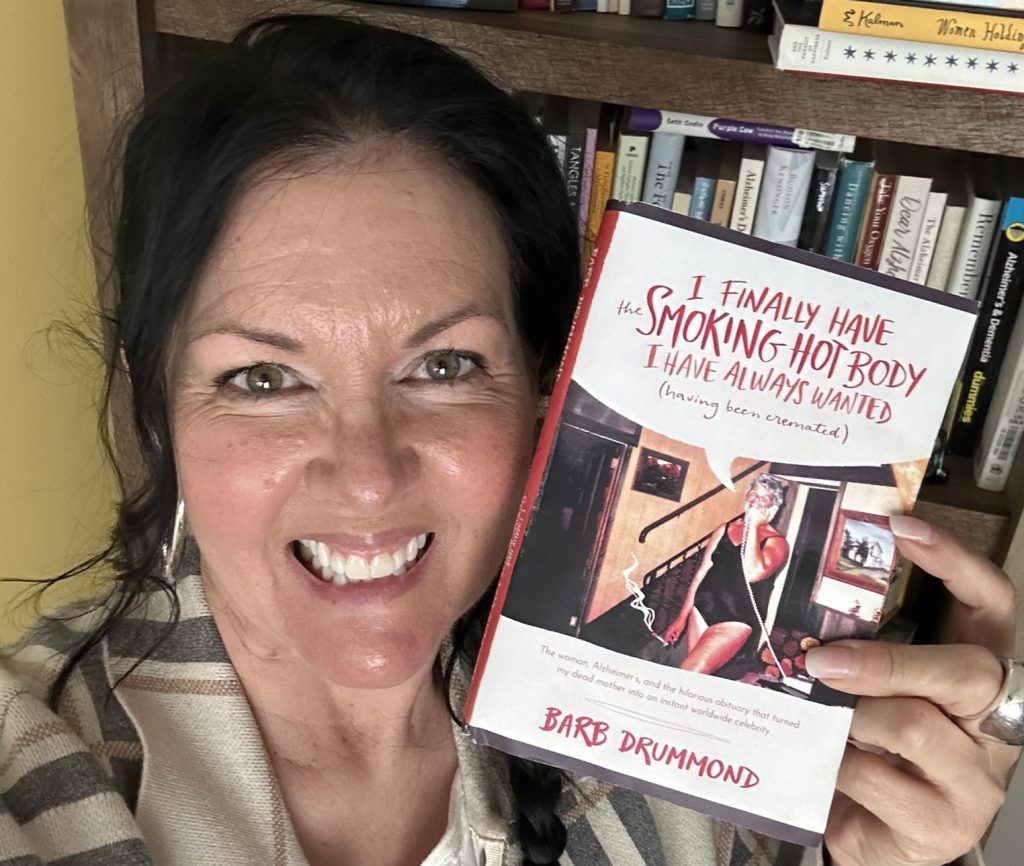
I Finally Have the Smoking Hot Body I Have Always Wanted (having been cremated).
Those words coined by Peace River’s Barb Drummond in her mother’s obituary quickly caught stranglehold on the internet and has led to the creation of a book reflecting on the illness that took her from her family.
“I wrote my mom’s obituary in 2019 in first person. Mom had lost her voice to Alzheimer’s for many years, and I wanted to give her voice back one final time to say goodbye,” says Drummond.
“It went viral and hundreds of thousands of people wanted to know more about Mom. I wrote her obituary and shared many of her antics, it was more like stand-up comedy than a funeral service, and afterwards people wanted more stories and said I should write a book, so I did.”
Drummond says she wrote the book as a memoir, a labour of love for her mother.
“The story takes place over about nine days when I go back to help prepare for her funeral,” Drummond explains.
“Throughout it I share silly stories and antics that happened while growing up and my relationship with Mom. She wrote me letters whenever I happened to venture off: university, Japan, Holland, and her letters followed.”
Drummond says she included the letters written by her mother in the story to share events and to help move the story forward.
“I wrote it with the intent that people would fall in love with Mom and then realize just what a gem of a person Alzheimer’s has taken from us, from the world,” she notes.
“She always had this massive presence and kind energy. It was horrific to see her reduced to a bed with a few personal pictures and items around her which meant nothing to her since she couldn’t remember the faces in the frames,” she adds.
Drummond explains many people are not aware of how impactful an Alzheimer’s diagnosis can be until they or their loved one is faced with the disease. She says her goal was to not write a how-to book on how to cope, but to write a book to share that others who are faced with the diagnosis know that it is OK to laugh, OK to cry and OK to have all the range of feelings.
“I want people to know they are not alone, perhaps the stories will resonate with others and give them a bit of laughter during a time that is anything but funny,” she says.
“Perhaps it will nudge people to seek help from their local Alzheimer’s societies knowing this is not a solo gig. Everyone needs help.”
Drummond says Alzheimer’s is known as the long goodbye, but it is difficult to truly say goodbye when the person is still alive, even if the disease has stripped them of their memories.
“I know I didn’t say goodbye and I live with guilt for sure,” she says.
“Perhaps this was my way of saying how much I loved Mom and that I absolutely adored her, that I wanted to be just like her. Maybe this is my way of telling her by sharing her with the world.”
Drummond says that writing the book was very difficult because going through her memory lane, she’d grieve over again with each story.
“Growing up, our family dealt with many situations with dark humour, it was a coping mechanism,” she says.
“Each day, each moment mom forgot we would experience losing her over and over again until she was completely beyond remembering. If that makes sense?”
Drummond says throughout the process of her mom falling ill and writing the book, a number of people asked if she would be tested for the Alzheimer’s gene, but she has concluded that she will not be tested.
“I am not sure I want to know that I have a higher chance of developing Alzheimer’s than others,” Drummond expresses.
“Will it make me more stressed and then somehow increasing my chances of developing it? Our youngest son Clark has Down syndrome and he has a 51 per cent or higher chance of developing Alzheimer’s – the thing is he doesn’t know that and can’t comprehend ‘Alzheimer’s, so I guess that is the silver lining if you think about it.”
She says that either way, no matter the choice made in getting tested or not, Alzheimer’s is a terrifying disease for the one who falls ill and their family.
“I will prepare that I will get it but I don’t want to officially know at this point,” Drummond says.
“A friend of mine was tested, and he has the markers for Alzheimer’s – I think he is a brave guy.”
Drummond is hopeful people will consider donating to the Alzheimer’s Society. Her initially release featured an Indiegogo campaign to help raise money and awareness for the Society, but it only ran from Sept. 18-27. Her book is set to release on Amazon on Oct. 1.
“People can help by sharing the book title and cover, Links to Amazon when it comes out and encouraging people to donate to the Alzheimer’s Societies and/or Associations (US) in their local communities,” Drummond concludes.
“If people are looking for a group to give their donation dollars, perhaps that is a group they haven’t thought about if they do not have someone in their life with Alzheimer’s.”