




Pearl Lorentzen
For South Peace News
Community Futures Lesser Slave Lake has started a Community Data Program (CDP) which allows organizations to sign up for a yearly subscription to a statistics service.
On Jan. 23, Community Futures and CDP did a presentation about the project.
The goal of the program is “getting access to data for a small geography,” said Michel Frojmovic from CDP in the online presentation.
CDP was founded in the 1990s by the Canadian Council on Social Development [now called Canadian Community Economic Development Network (CCEDNet)], said Frojmovic. The original focus was to track poverty in neighbourhoods. When government funding dried up, the CDP shifted to a cost-share model.
In this model, a group starts a consortium. In this case, Community Futures.
Municipalities, newspapers, colleges, non-profits, libraries, urban planning groups, and others pay a $150 fee to join. Community Futures may charge an additional fee. The fees cover one-year access to local statistics and support from experts.
The CDP has data that is Canada-wide, but can only be accessed by members, which must be located with the geographic boundaries (called a catchment area) of a consortia.
The Merriam-Webster Dictionary defines consortium (plural consortia) as “an agreement, combination, or group (as of companies) formed to undertake an enterprise beyond the resources of any one member.”
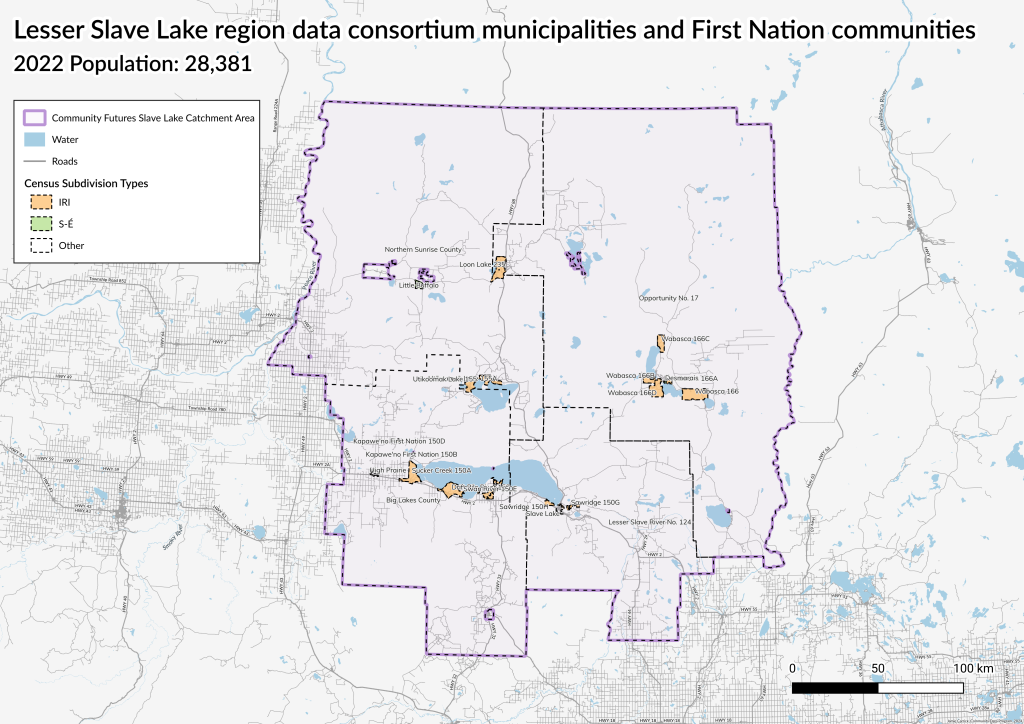
The Lesser Slave Lake region CDP data consortium has a population of 28,381 in 2022. To search the database, you need to know the census name of the community. This isn’t always the same as the community name. For example, the word Bigstone has no hits – instead people have to search Desmarais or Wabasca (166 to 166D). Driftpile Cree Nation is Drift Pile River 150 and Loon River First Nation is Loon Lake 235.
Census names in the catchment area: Big Lakes County (includes East Prairie, Gift Lake, and Peavine Métis Settlements), Desmarais, Drift Pile River 150, High Prairie, Kapawe’no First Nation 150B, Kapawe’no First Nation 150D, Lesser Slave River No.124, Little Buffalo, Loon Lake 235, Northern Sunrise County, Opportunity No. 17, Sawridge 150G, Sawridge 150H, Slave Lake, Sucker Creek 150A, Swan River 150E, Utikoomak Lake 155, Utikoomak Lake 155A, Wabasca 166, Wabasca 166A, Wabasca 166B, Wabasca 166C, and Wabasca 166D.
A few communities within the geographic area not included: Woodland Cree Nation (including Cadotte Lake) and the Town of Swan Hills. One Bigstone reserve (Jean Baptiste Gambler at Calling Lake) and Chipewyan Lake and Calling Lake in the M.D. of Opportunity are outside of the area.
Organizations from these communities are not eligible to join the consortium, but any registered member can access information on these communities as the data is Canada-wide.
Across Canada, CDP has over 30 data consortia, over 425 member organizations, and over 2,400 workers from these organizations who have access to the data.
There’s no limit to the number of employees or volunteers who can have access, said Frojmovic.
Organizations interested in accessing data, please go to www.communitydata.ca.