





Richard Froese
South Peace News
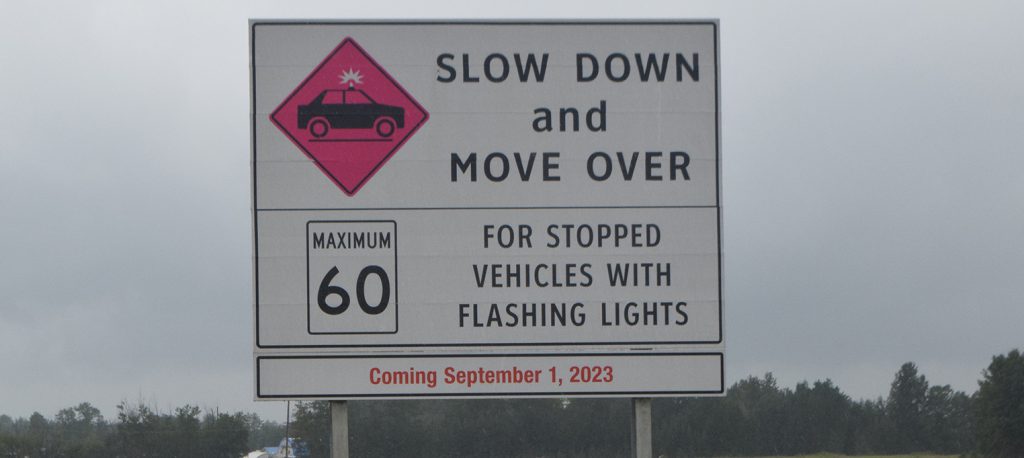
Motorists are being warned about new roadside laws where drivers are required to slow down to 60 km/h where roadside workers are located beside highways – or face fines – starting Sept. 1.
Keeping workers and motorists safe on the road is a priority of the provincial government, says a government news release Aug. 8.
To increase safety for all roadside workers, starting Sept. 1, drivers in the lane closest to any roadside worker vehicle stopped at the side of the road with its lights flashing must slow down to 60 km/h or the posted speed limit, whichever is lower.
Drivers must also move over to the far lane if it’s safe to do so and take reasonable steps to allow other drivers to move over as well.
Violators face variable fines and demerit points for failing to slow down to 60 km/h or a maximum speed, whichever is lower, when passing stopped roadside workers.
The fine and demerit points increase on an escalated scale based on how much the driver exceeds the speed limit.
Violators face a $243 fine and three demerit points for failing to allow other drivers to move into a traffic lane farther from a stopped emergency vehicle, tow truck or roadside work vehicle.
During winter months, violators face a $324 fine and three demerit points for unsafe passing of snowplows.
Currently, only tow truck drivers and first-responders are protected under the Traffic Safety Act.
But now, all roadside workers on the side of the road, with their flashing lights activated, will be covered by the new law.
“If you see any flashing lights and people working on the side of the road, slow down to 60 km/h or move over to an open lane beside them,” Transportation an Economic Corridors Minister Devin Dreeshen says in the news release.
“We want to protect our police, paramedics, maintenance workers and tow truck drivers so they can get home safely at the end of the day.”
Slowing down and moving over for all roadside workers will keep everyone safe and ensure traffic continues to flow efficiently.
“The Alberta Association of Chiefs of Police (AACP) is committed to road safety for all Albertans,” says Leticia Aplin, executive director of the AACP.
“This initiative of Transportation and Economic Corridors is another step towards enhancing these goals.
“We look forward to working to the ministry and other partners to further the work of keeping motorists safe on our highway.”
According to Alberta’s Workers’ Compensation Board (WCB), Alberta recorded 2,229 injuries involving workers being struck by a vehicle from 2014-18.
About 130 collisions involving snowplows contracted by Transportation and Economic Corridors were recorded from March 2018 to March 2021.
During the winter of 2022-23, 37 collisions involved a government-contracted snow- plow.